Bruce Douglas Reeves, Author

  • HOME
  • Bio
  • Books
  • Excerpts
  • Stories
  • Blog

A MARRIAGE IN MOTION, 41: China, Kingdom of Bicycles

2/24/2018

0 Comments

 
Sherrill, my wife, and I visited together more than 60 countries and most of the United States during our 52 years of marriage.  This is number 41 of a series about our lives and travels. If you scroll down, you'll come to earlier posts in this series.  To start at the beginning of our marriage look at the Archives list in the sidebar and start with May, 2017. Older posts are a previous series about much later travels.
​
​              "They're going to dam the Yangtze," Sherrill told me.  "We have to go there soon."
              We wanted to experience those spectacular, deep gorges before they were filled with water and silt, but, she explained, we had to travel with an approved tour company working under the Chinese system—much as we had in the Soviet Union.  This, we discovered, would lead to some much-too-interesting experiences.
              Flying in China in 1993 was not just an adventure; it was a pinball game with death, a comic book version of Ingmar Bergman's chess game with the Grim Reaper.  All of the interior walls of our ancient China Air 747 (it once had belonged to Aeroflot) had been removed so that we could see the lack of service from one end of the plane to the other.
              We're going to have to be flexible," Sherrill whispered.
              This turned out to be the monarch of understatements. 
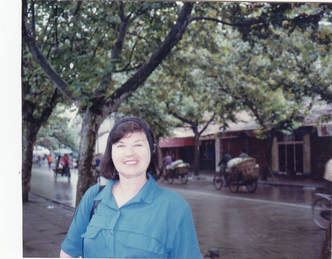
PictureSherrill: China street scene with pedicabs
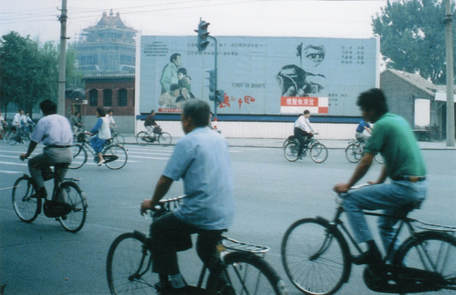
           Beijing then was a city of ten million people and nine million bicycles.  Every day, we encountered thousands of those bikes carrying people to and from work and everyplace else.  Most of them didn't bother with lights or reflectors at night.  At least, we told each other, they weren't cars. 
          Private businesses, we were told, had just become possible in China.

​              "We all want our own business," "Rick," our young Chinese guide explained.  "It is part of new Freelance Responsibility System.  We can even buy stocks in new state-owned businesses.  We line up when certificates that let us buy shares are offered—sometimes all day and all night.  No more communes.  Farms private owned.  Farmers pay some profit to government, keep rest."
              "Doesn't that go against communist-socialist beliefs?" I asked.
              "No.  Like Chairman Deng say, no matter cat black or white if catch rat."
Picture
Beijing, 1993: Kingdom of Bicycles
​              We were free to wander on our own, when we had the opportunity, but had to spend most of our time under Rick's helpful guidance and protection.  He showed us the expected sites, the Forbidden City, Tiananmen Square, the Chinese opera, and, in side trips, the Ming Tombs and the Great Wall and factories where we could buy souvenirs ranging from cloisonné to woodblock prints to silk clothing and needlework.  Along the way, we also managed to see a lot more, as well.  
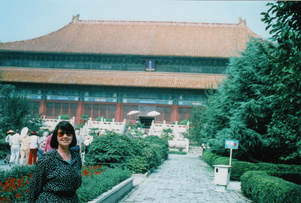
PictureSherrill, Hall of Heavenly Favor, Ming Tombs
           In a couple of parks, we watched a stately herd of middle-aged couples fox-trotting  to old American songs and another group of elderly men and women practicing slow motion Tai Chi.  As we explored Beijing and later Shanghai, Xian and other cities, we came across many old, traditional neighborhoods being torn down.  Progress, no doubt, Rick would have insisted.  We saw construction workers busy day and night in every city and noticed that no safety precautions seemed to be taken either on the rickety bamboo scaffolding or around the building sites: wires, broken tiles, building supplies, and other debris were scattered everywhere.  

​              "Tell us more about you," Sherrill asked Rick on the bus, one morning.
              Surprisingly, he was very open about his life.  His father had been an engineer until the Cultural Revolution, when he was sent to do manual labor on a farm, plummeting his family from prosperity into poverty.  However, as a small child Rick was selected because of his body type for the state's special athletic school.
             "I was happy that because of me my family now had better life.  Swimming and table tennis were my sports.  World championship my goal.  I worked at them thirteen hours a day, but was miserable because I was growing up uneducated.  Finally, when fourteen I quit that school and went to Language Academy to learn English, but then I have to serve state as tour guide."  
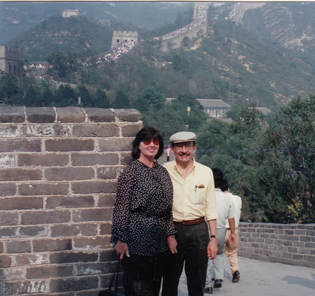
PictureSherrill & Bruce on Great Wall
          From Beijing we flew to Xian, a growing city of nine million, its dusty streets crowded with bicycles.  Our next flight, a few days later, after we'd explored the area with Rick and visited the first emperor's terra cotta army, did not go smoothly.  After checking into the little airport at 6:30 AM, we heard that our flight to Chongqing was delayed.  It seemed that a workman had poured something into the wrong hole on the airplane, so the airport needed to find another plane for us.  

              Finally, we reached Chongqing, then China's most populous city, with 13 million people.  This was where we were supposed to begin our Yangtze River cruise, Rick told us, but because of recent storms the currents were too fast for our ship to make it upriver to the Chongqing dock.  Then he told us that a smaller boat would take us downriver to meet the ship, instead.  Other tour groups in other buses joined ours and all five buses wound through the narrow streets toward the river.  Driving through what once was the heart of the city, we passed old office buildings, hotels, and stores, now abandoned and waiting to be demolished.  We stopped in a grimy alley perched above the wide brown river.  
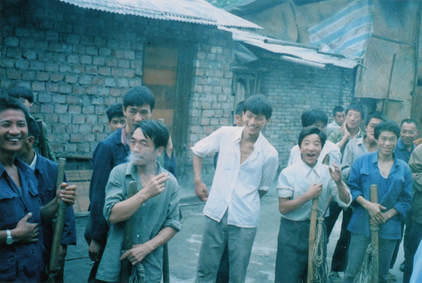
PictureYoung porters eager to carry bags to ship, Chongquing
        Filthy gray shanties were jammed like rotten teeth against the remains of decaying commercial buildings.  All of this area would be flooded when the Yangtze dam was finished.  Soon, our buses were surrounded by young men in rope sandals with poles and baskets.  They wanted to carry our bags down the flights of slimy, broken steps that descended to the water's edge.  It turned out, though, that no boat had come to take us downriver to the ship.  

            All the tour directors and guides conferred and returned.  Now, Rick told us, the five buses would go over the mountains to the waiting ship, maybe a two-hour trip, although since none of the guides and drivers had ever done it, nobody could say how long it would take.  The buses wove like a covered wagon train on the narrow roads out of the city and into the mountains.  The roads we were following weren't on any map our drivers and guides had. The country we passed through grew lush and tropical, with terraced rice and lotus fields, occasional villages and farmsteads, everything shimmering shades of yellow-green.  
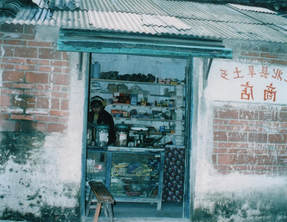
PictureMountain village herb shop
          At first, the detour over the mountains seemed like an adventure, but the road, although paved, wasn't much wider than the bus.  When we passed farm houses or villages, local people stared at the spectacle.  How could five full-sized buses attempt this steep, constantly switch-backing road over the mountains?  Swaying and groaning, our bus would abruptly descend, then climb again.  Often, we couldn't see either the buses in front or behind us.  After more than two hours, our bus lurched off the paved road and stopped in a wide muddy  place near what might have been called a village.  The first two buses were already there.  Eventually, the last two caught up.  Passengers had the choice to use the very primitive lavatories—or go into the rice paddies. 

​             "We're seeing a part of the country we never would have," Sherrill commented.
             "But did we want to?" countered another passenger. 
            The detour was turning into more of an adventure than most of the passengers wanted.  Wandering over the mountains, we were losing time on the ship, and people were worrying that we wouldn't reach it by dark.  Did the drivers know where they were going?  The dirt road was twisty and often steep, not built to accommodate large tourist coaches.  From time to time, we passed farmers or children on the road, as well as carts, small trucks, and tiny tractors, and once a battered mini-bus.  Occasionally, we skidded in the dirt, sliding sideways before moving forward.
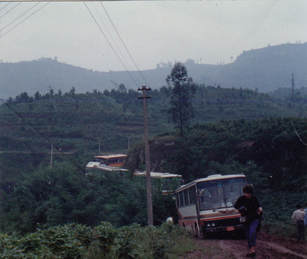
PictureThe five buses on the mountain detour
            "Don't look!" Sherrill told me.
        Then muddy pockets opened up in the road, which the busses churned through, roaring up and out of them as quickly as possible, but they came more and more often as the road became narrower and steeper and the buses slid and maneuvered more.  A storm the day before had washed away parts of the cliff, possibly sections of road.  Finally, as the sky darkened, we spied a wedge of greenish-gray water in the distance, between two mountainsides: the river—the end of this impromptu and frightening journey—but it vanished again.
          Then we came to an abrupt stop. 
          Something had happened in front of us.  Rick jumped out of our bus and ran to the coach ahead.  On a narrow curve, trying to pass a small tractor pulling a load of rocks through deep muddy tracks, the second bus had lost momentum and slipped in the mud until its right rear wheel was hanging over the cliff edge.  Rocks were placed under the other three wheels and the hysterical passengers—a group of Canadian Chinese—got off the bus.   

​              The first bus had got around the tractor, but it wasn't going to be easy to get the second bus back on the road and three other buses were trapped behind it, with passengers of all ages and conditions.  Any one of the coaches could have slipped and fallen over the edge.  Everyone was terrified in retrospect—and equally outraged.
              Rick told us that the ship was only a mile or so away, mostly downhill.  Some passengers from the other buses were striking out, carrying their hand luggage, to walk to the ship.  Local farmers would be hired as porters to carry bags for anyone who couldn't carry his own. 
              "All the larger bags are already on the ship."
              "Wanna bet?" one of the passengers countered. 
              "Ship?" said somebody else.  "You think there's a ship down there?"
             So, four busloads of tourists from around the world began trudging through the slippery mud on the cliff-side road.  Then, moments after everybody had started hiking: rain.
             Sherrill pulled her folding umbrella and rain hat out of her purse, I rolled up my trouser cuffs, and we continued the trek along the rain and mud-filled tracks.  Sherrill loaned the rain hat to an eighty-one year-old woman we'd got to know.  Rick trotted up and down among us, grinning and joking, apparently trying to keep up our spirits.  
              "All will be okay!  Be happy!"
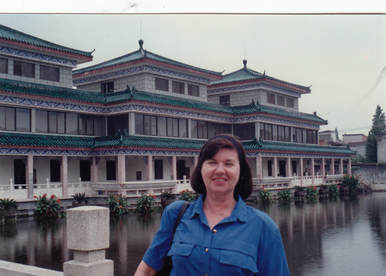
PictureSherrill, Jingzhou Museum
     Eventually, we began the descent down a gooey trail toward the ship.  There she was: the White Emperor.  Low slung, tired looking in the gray drizzle, three decks high, white paint dirtied by the storm, the ship waited like a beached whale beyond sprawling mud flats.  Slowly, we all crossed a bridge of loose planks floating on the mud.
      "Welcome," we were greeted by several young hostesses in burgundy velvet dresses slit to the thigh as they passed out wet washcloths to us, and we maneuvered through the lobby crowded with luggage to get our room keys.  The moment everyone was on board, the ship's engines jerked into action, trying to make up for lost time. 
           In addition to everything else, this ship wasn't the one we were scheduled to be on.  That ship, the new Yangtze Princess, had been commandeered by the Chinese government for a group of VIPs, so five bus loads of less important tourists were put on this boat.  That ship probably would have made it upriver to Chongqing.  We soon discovered that the White Emperor crew wasn't used to western tourists.  Few of them spoke English or other European languages. 
           "We're on the Yangtze!" Sherrill exclaimed, giving me a nudge.  "Be happy!"
​
To be continued....​

Picture
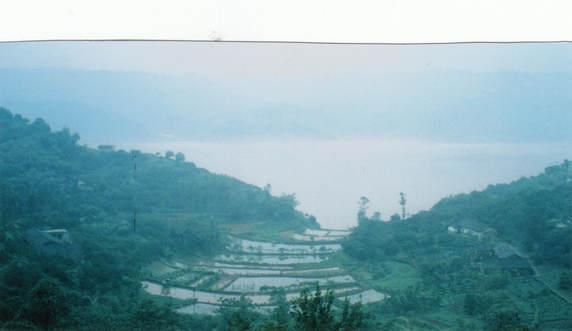
Rice terraces and the Yangtze viewed from the mud road
If you enjoy these posts, why not explore the rest of my website, too? Just click on the buttons at the top of the page and discover where they take you—including to several complete short stories and excerpts from my novels.  Please pass them on to anybody else you think might enjoy them. 
​
0 Comments

A MARRIAGE IN MOTION, 40: Mini-Trips Can Be the Best

2/17/2018

0 Comments

 
​Sherrill and I visited more than 60 countries and most of the United States during our 52 years of marriage.  This is number 40 of a series about our lives and travels. If you scroll down, you'll come to earlier posts in this series.  To start at the beginning of our marriage look at the Archives list in the sidebar and start with May, 2017. Older posts you'll find below that are a previous series about later travels.  
​              "What was your favorite trip?  Your best trip?" people often asked us. 
              The difficulty answering the question was that the trips were so different from each other, but the ones that meant the most to Sherrill and me often were those with family and friends, even if they were only for a week—not necessarily the trips when we flew across the world for a month in China or a cruise on the Nile or some other exotic destination, exciting as those adventures were.  Shorter trips often were more spontaneous and easier to fit into our lives, as well, so we did quite a few of them over the years, each full of good memories.  
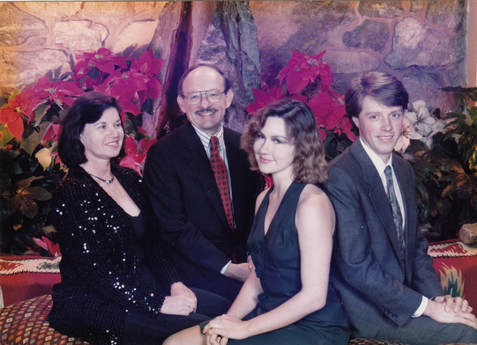
​              Perhaps the most memorable was at Yosemite in December, 1992.  For several years, Sherrill had tried to get us four places at the Bracebridge Dinner, an annual Renaissance Christmas pageant and feast in the great hall of the Ahwahnee Hotel.  They were chosen by lottery because the event was so popular.  Finally, at the last minute that year, we were lucky.  The traditional dinner was presented as if at an English manor house 500 years ago, in full costume, with the Lord of the Manor, his wife Lady Bracebridge, jester, musicians, chorus, and household staff, a joyous spectacle and experience—very Henry VIII.   
Picture
Sherrill, Bruce, Simone, & Paul at the Bracebridge Dinner, Ahwahnee Hotel, Yosemite
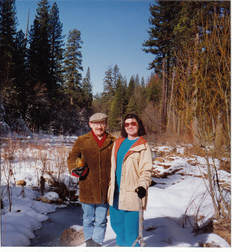
             Sherrill, Simone, and Paul and I discovered a Yosemite transformed by snow and ice.  Even the waterfalls were frozen icy ribbons.  I remember that as we walked along the wide side porch into the Ahwahnee, past icicles hanging like shining weapons from the hotel eaves, we discovered a family of raccoons on the snowy hill just beyond the rough-hewn railing.  Up above, a female and several young raccoons were foraging, while down below, near the railing, a massive male was standing watch, ready to attack if any human had the audacity to move too closely to his family. 
PictureBruce and Sherrill, Yosemite
​              That holiday at Yosemite was a great experience, but over the years we enjoyed other mini-vacations there through all seasons.  One year, Sherrill and I took grandson Leo on a snow outing there, traveling by train and bus.  Several times, we went with family or friends in the spring, when waterfalls were at their fullest and wild flowers in bloom.  We didn't need to cross international datelines for memorable experiences.

​              Some of our favorite mini-trips in the early days began with the drive north toward Napa, where we could taste wine and picnic (the area wasn't crowded with restaurants, gourmet or otherwise, then) and maybe tour a winery.  In the autumn, the trees and vineyards displayed a dazzling array of fall colors.  Only a few wineries lined the main road then and none of them charged for tasting.  As a courtesy, though, we often bought a bottle, afterwards. 
              One year, when we were exploring the area with our young daughter, Sherrill turned onto a side road and we discovered the little spa town of Calistoga.  It wasn't developed much then and still had a late nineteenth century feel.  We found only two places to eat, a tiny pizza joint and a western style bar/restaurant.  Maybe three or four spas were still functioning, all but one in ancient "picturesque" facilities.  We stopped at the newest-looking one, booked a room, and made a reservation for me to have "the works" later. 
              "You're not getting me up to my chin in that black mud!" Sherrill insisted.
              While I was indulging, she and Simone would relax in the big indoor hot pool.  First, however, we needed to find a place to buy swim suits.  This was truly a spontaneous adventure, but the first of many annual visits.  
         Mendocino on the northern California coast back in the 1970s was a special place, scarcely discovered yet by tourists, rural, beautiful, and unspoiled.  We'd heard that a few communes were surfacing in the hills, but they weren't visible.  We actually considered forming, with friends, our own commune up there, but it was too far away from the "civilization" of the Bay Area for most of us.  However, we had some happy times, enjoying the half-tamed beauty of the area. 
            Shakespeare in the woods: that was the original draw of Shakespeare Santa Cruz at the University of California Campus above the beach town south of the Bay Area.  The Santa Cruz mountains no doubt hid some choice spots for a commune, but real estate in that area already was getting pricy, although we all agreed that Santa Cruz was a nice little town.  Over the years, we had some fine vacations there, sometimes with friends at the Shakespeare festival, sometimes with family at the Boardwalk and beach.  
​            Shakespeare was the main attraction of Ashland, Oregon, too.  A pretty little town just above the California border, its annual Shakespeare festival drew more and more visitors each year.  Gradually, as the festival grew, the city grew, more places to stay and eat appearing around the town.  Somehow, though, the place retained most of its charm.  Sherrill and I lost track of the numbers of times we drove up to enjoy the festival, sometimes with our daughter, and, often, good times with friends.  
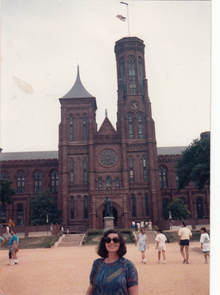
PictureSherrill at Smithsonian, Washington D.C.
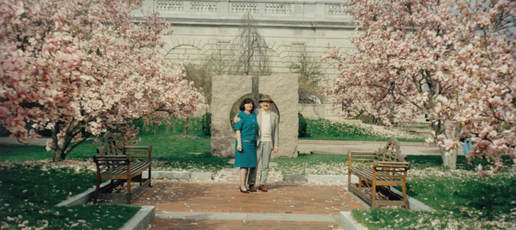
             Over the years, we flew to Washington D.C.  many times to visit my aunt and uncle, see the museums, and explore different parts of the area—sometimes just with Simone, once with both Paul and Simone, sometimes just the two of us.  Once, grandson Leo and I went alone.  No matter how often we went, we always discovered something new and exciting and it was always fun to be with my aunt and uncle.   

Picture
Sherrill & Bruce, Spring, Washington D.C.
            Another place that we often visited for mini-vacations was Honolulu, where Sherrill's mother lived.  Hawaii also never got old. We went there several times with little Simone, then with teenage Simone, then with Paul and Simone together, and still later with little Leo, too. When Simone was small, Sherrill and I took her to Disneyland in southern California.  A generation later, we took five year-old Leo there.  The park may have added new attractions, but it seemed more or less the same fantasy paradise with no connection to reality—not even the so-called Main Street USA.  Of course, Disneyland is best enjoyed when you can do it through the eyes of a young child.  
           Oregon often drew us for days or a week, because of its beauty and because we had friends up there.  Once, Sherrill and I took the train from Oakland to Klamath Falls, but usually we drove north.  Sometimes, we stayed in Medford or Ashland, other times went further afield to Lake Mary, where we rented a cabin with our friends, or to spectacular Crater Lake, once to a resort area near Bend, and once to visit a friend in Eugene.  At least a couple of times, we prowled around Portland, green and civilized, but sometimes quite damp.
              "We could live here," we agreed, "if it weren't so wet." 
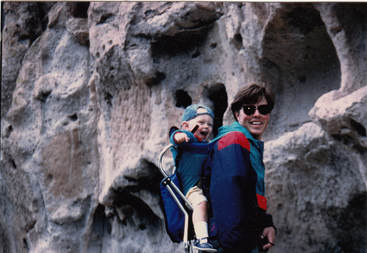
PictureLeo and Paul, New Mexico
           A week in New Mexico with Simone and Paul and one-and-half year-old Leo turned out to be one of our best mini-vacations.  Leo seemed to enjoy every minute of the trip, starting with the airplane, and we enjoyed his enjoyment.  Paul and I took turns carrying him on our backs, which he also liked.  He doesn't remember any of it today, but we covered a lot of ground, exploring native American sites, Spanish missions, and Santa Fe.  We spent hours hiking among the pueblo-style buildings and visiting art galleries and museums.  The sun was hot and bright and the shadows thrown down by the flat-roofed buildings were cool and black.  Evenings, we took turns going to dinner while one of us watched Leo and Sherrill stayed with him part of one day while the other three of us went gallery hopping.  

​           Sherrill loved to plan and organize trips.  Although from time to time she tried to weed the files she'd put together for possible future adventures, new possibilities were added as fast as others were eliminated.  Then, at  the right time, she'd pull out just what we needed.  
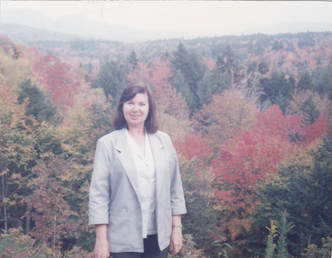
PictureSherrill, Autumn Foliage, New England
        "The Fall colors in New England will be perfect next month," she told me, one year,
showing me clippings she'd saved and an itinerary she'd worked out.  The plan turned into a perfect swing through several states, with a side trip to upstate New York to visit friends and another stop at Mark Twain's home in Connecticut.  In her enthusiasm, as we were driving among the gloriously colored trees, Sherrill saved some of the leaves and mailed them back to Simone in Berkeley—somewhat perplexing our daughter, since the leaves had lost their color by the time they'd crossed the continent.  

          Another file folder revealed everything we needed to know for a  perfect trip to San Antonio, Texas.  Well, almost everything.  As much as Sherrill and I enjoyed the River Walk and the historic sites and missions, we weren't expecting an infestation of locusts while we were there:  drifts of them piled against the hotel doors and in front of the Alamo across the street.  When I tried swimming in the hotel pool, they floated up against me, I got handfuls of them with each stroke, and they drifted into my ears and mouth. 
          After Sherrill retired (almost a year before I did), she decided that she was going to surprise me with a series of weekend mini-trips that she'd put together while I was at work.  One weekend, she drove us to the Gilroy Garlic Festival, where we sampled everything made from garlic, including garlic ice cream.  Another time, we spent a weekend at a Japanese-style spa in San Francisco's Japan Town. I think surprising me was as much fun for her as any trip, itself. 
            A weekend jaunt to the Hearst castle at San Simeon turned out to be quite an adventure.  As part of the surprise, we rode the train south to San Luis Obispo and then took a bus tour up the coast to the "enchanted mountain" and the castle, all very Citizen Kane. 
          "Just think," I whispered halfway through the tour, nodding toward the grotesquely huge dining room table.  "Garbo sat there." 
           "Yes, dear.  And Marie Dressler!" 
           On the way down the hill after the visit, we saw a knobby-kneed giraffe loping through the long dry grass and several other exotic animals left from Hearst's private menagerie. 
             I had to go to a conference in Chicago one year to give a speech about employee communications.  Sherrill was retired, so she came with me—not to hear my speech, but to do some sightseeing on her own, including a boat tour among the skyscrapers on the Chicago River and in Lake Michigan.  After the conference ended, we stayed another few days, turning the business trip into a mini-vacation.  We even took in a play at The Auditorium, the 1889 theater designed by Chicago architect, Louis Sullivan.  One of the best parts of the trip, since we both were fascinated by architecture, was seeing the historic, once radical, buildings of the city. 
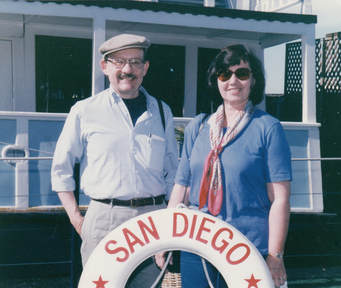
PictureBruce & Sherrill, San Diego, after Mini-Cruise
           "We're taking a cruise this weekend," Sherrill told me one Friday evening—a two-day trip, she added, sailing from San Francisco to San Diego, overnight there, then flying home.  "It'll be fun." 
          When she said a trip would be fun, it always was.  How could I doubt her? 
             The little ship, a baby when compared with modern cruise liners, stuck pretty near the California coast on the way south. The weather was nice, but Sherrill hadn't booked a room for us since it was such a short trip, so we had to wander around the boat until we docked in San Diego.  Most of the ship seemed to taken up with casinos, bars, and restaurants, loud music blasting from all of them—music that we couldn't escape.  Everyone but us seemed to be drinking, dancing, or gambling without stop. 
           "A party boat," Sherrill pointed out.  
           The deck was somewhat quieter, but we couldn't stay outside for the whole trip. 
           "It was a bargain," she told me.  "You wouldn't believe how cheap."
           "No," I said.  "I'd believe."
           However, we did enjoy San Diego and had a comfortable flight home. Afterwards, I didn't tease her about her bargain cruise—not too much. 
​
To be continued.... 
​

If you enjoy these posts, why not explore the rest of my website, too? Just click on the buttons at the top of the page and discover where they take you—including to several complete short stories and excerpts from my novels.  Please pass them on to anybody else you think might enjoy them. 
You also might enjoy reading the new bargain-priced e-book of my first novel, The Night Action.  First published in 1966, it has been called the last great novel of a past era.  "The novel careens around the night spots of San Francisco's North Beach and the words seem to fly off the page in the style of Tom Wolfe or the lyrics of Tom Waits."  The book is available at Amazon and Kobo.    Click on the title for the link.    Or Here.
​ Or here: Goodreads. 
0 Comments

A MARRIAGE IN MOTION, 39: Koblenz to Berlin in Unified Germany, 1992

2/10/2018

0 Comments

 
​Sherrill and I visited more than 60 countries and most of the United States during our 52 years of marriage.  This is number 39 of a series about our lives and travels. If you scroll down, you'll come to earlier posts in this series.  To start at the beginning of our marriage look at the Archives list in the sidebar and start with May, 2017. Older posts you'll find below that are a previous series about later travels.   
 
PictureSherrill in Potsdam, Germany, 1992
​           It's the confluence of the two rivers," Sherrill told me.  "Something we have to see."
          Her excitement at the prospect was catching, so now I was looking forward to it, as well.  
           A four-hour boat trip along the Moselle took us from historic  Cochem in the wine-producing Moselle Valley to the city of Koblenz, where  the Moselle met the bigger Rhine at the Deutsches Eck, or "German Corner," a  massive concrete triangle that poked its snout between the two rivers as their currents collided.  We could see the two rivers battling it out, stirring up wild foamy patterns in the water.  An ugly statue looked over the confluence from our side and a massive, ugly fortress stood on the cliff opposite, but the combative meeting of the rivers between them was beautiful.  
              "Now, I understand why you wanted to see this," I told Sherrill.
              She just smiled in reply.  

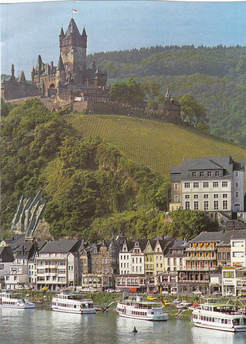
PictureCochem & Reconstructed Castle
​              Koblenz has a long history, but much of it was wiped out during World War Two.  Stubbornly, though, while we were there, the city was celebrating its two thousandth birthday—although most of the buildings that looked old were modern reconstructions.  We did enjoy strolling with everyone else along the river esplanade and in the old town, whether the buildings were original or not.
              Dusseldorf, like so much of Germany, also suffered from massive bombing during the War, so there wasn't much left of its old city, either, although the new city had a stylish energy—especially the Konigsallee, a shopping boulevard shaded by chestnut trees.  We window-shopped at the high-end clothing stores, dropped in at three museums, and ate at a sidewalk cafe opposite the canal running down the center of the street.  Gold leaves blew around our feet, I remember, but the air was still warm.  It all was very pleasant, but we could have been anywhere in the world.  The city seemed to have turned its back on both the Rhine and the past.  

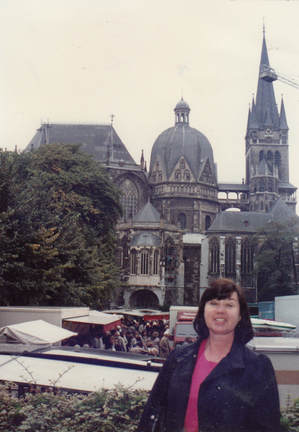
PictureSherrill, Aachen Cathedral & Street Market
​           Another trip highlight for Sherrill was the ancient city of Aachen.  She'd been looking forward to seeing Charlemagne's marble throne in the cathedral—not to mention the gold, head-shaped reliquary holding part of his skull.  And what about the arm-shaped reliquary with the bones of his forearm, which we could admire through a little window in the armor?  The rest of his 1,200 year-old skeleton presumably was in his sarcophagus, but we couldn't see inside it.  Years after we were there, however, it was opened and scientists confirmed that the six foot tall man whose bones were found most certainly was "the father of Europe," Emperor Charlemagne. 
              Sherrill always enjoyed discovering another reliquary displaying another holy body part, but Aachen  had the biggest cache since the village of Conques on the way to Santiago de Campostela.  She knew all about Charlemagne and his passion for relics.  While his church was being built, he sent messengers to Jerusalem and Constantinople to buy relics for him.  The "Four Great Aachen Relics" in his collection reputedly were: the garment worn by Mary on the night of Christ's birth, the swaddling clothes of the Infant Jesus, the blood-stained loincloth of Jesus on the cross, and the cloth used at the beheading of John the Baptist. 
              "They're all here," she told me.  "In that."
              She pointed to a gold, jewel-encrusted statuette of Mary and baby Jesus.
              "But we can't see them."
              She smiled.  "You have to take it on faith, dear, that they're inside." 

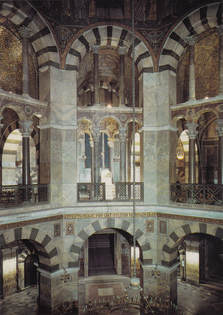
PictureCharlemagne's Throne, Aachen Cathedral
​              For more than a thousand years, pilgrims had done that—without any proof except tradition.  In our guidebook, Sherrill had written one word next to the description of these relics in the Aachen cathedral: "WOW!"  Another valuable relic in the cathedral, even if not a body part, was a link from the chain that once imprisoned St. Peter.   
              I was impressed that Charlemagne's chapel, with his tomb and white marble throne,  dated back to the year 800.  When we were there in 1992, damage from World War Two still was being repaired.  As if to underline the passage of time, across the street from the cathedral stood a shiny new, very popular, McDonald's restaurant—a small version of its golden arches discreetly above the doors.   

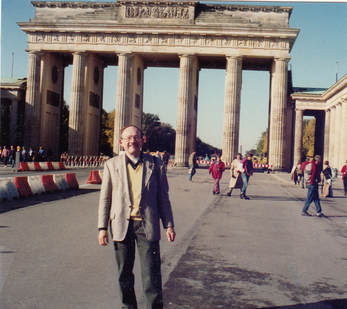
           We hated to leave Aachen, but finally had to take a train east across Germany to Berlin, a different city than the one we'd experienced in 1988.  It was hard to believe that less than five years had passed since we'd made our way around a divided city and spent almost an hour passing through Checkpoint Charlie, now history.  For the most part, the wall was gone, except for remnants for tourists to gaze at, but huge empty spaces—including the vast No Man's Land stretching next to it on the eastern side—still revealed where it had been. 
              "A lot valuable real estate is going to be available for development, now," I told Sherrill.
              "And who is going to develop it?" 
              "That's the question, isn't it?" 
PictureBruce & Brandenburg Gate, Berlin -- no Wall in front, this time
​          One piece of real estate that was still undeveloped, somebody told us, was above Hitler's bunker.  Apparently, debates were still going on about what should be done with it.  Above all, the government didn't want anybody to build a shrine on it.  I smiled, but was told that it was no joke.  There were people who'd do it, if they had a chance.
          Now that the borders between east and west were gone, it was easier to get around the city, although some U-Bahn trains from the west still couldn't stop at stations in the east.  We took some day trips out to Berlin's suburbs, including Potsdam, where the allies met at the end of the War in 1945.  We stood in the very room with the same table and chairs in the Cecilienhof Palace where Stalin, Truman, and first Churchill and then Clement Attlee from Britain met.  The palace had been built in an English Tudor style, but felt very Germanic.  We both had the same thought at that moment: this was where the future history of the world was determined, for better or worse.  
            "There's one more place we have to see," Sherrill told me as we left the palace, "as long as we're in Potsdam."  

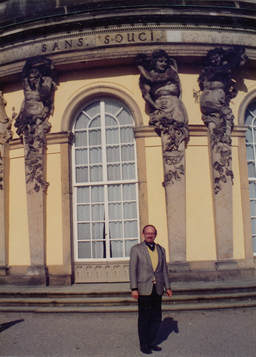
PictureBruce at Sans Souci, Potsdam
       It turned out that she was referring to Sans Souci, Frederick the Great's summer home.  The name translated as "without worry or care," the theme for his place of escape.  Of course, since he was king of Prussia, his summer cottage was intended to rival Versailles.  It wasn't as big, but the rococo palace and its gardens, with their light-hearted follies scattered among the walkways and greenery, appealed to the decorator and designer in Sherrill.  
            Despite the elaborate rococo decorations throughout the palace, it preserved a lightness that gave it a good deal of charm.  The surprises popping up in the garden, around a corner or beyond a hedge or tree, added a pleasant sense of anticipation as we strolled through it.  Looking back, I can see how Sherrill was inspired by Sanssouci—as well as, of course, other places large and small that we visited over the years. 
           Surprises await the visitor throughout our own much smaller garden: it might be a mirror in a corner, a five foot tall giraffe behind a tree, a little pagoda under a shrub, or one of two dozen other animals scattered among the plants.  The idea, she said, was to give joy, and the surprises that she tucked away in our garden did and do give joy.  Her goal in the house was an uncrowded lightness with its own carefully placed details adding variety and aesthetic pleasure.  Sometimes, I didn't understand what she was doing or why while she was doing it, but I learned to appreciate and admire her efforts—whatever inspired them, a magazine article, something she saw on a trip, or her own sense of whimsy. 
To be continued.... 
​

If you enjoy these posts, why not explore the rest of my website, too? Just click on the buttons at the top of the page and discover where they take you—including to several complete short stories and excerpts from my novels.  Please pass them on to anybody else you think might enjoy them.  
​
0 Comments

A MARRIAGE IN MOTION, 38: Exploring Along the Rivers of Germany

2/3/2018

0 Comments

 
​Sherrill and I visited more than 60 countries and most of the United States during our 52 years of marriage.  This is number 38 of a series about our lives and travels. If you scroll down, you'll come to earlier posts in this series.  To start at the beginning of our marriage look at the Archives list in the sidebar and start with May, 2017. Older posts you'll find below that are a previous series about later travels.   
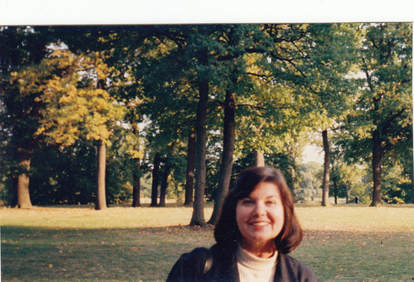
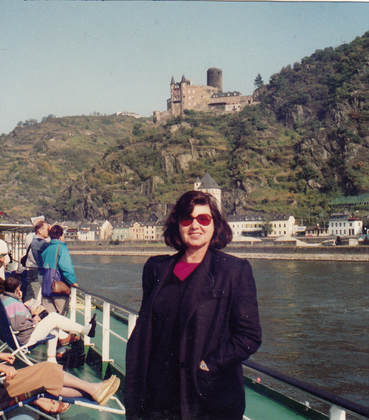
PictureSherrill on the Rhine
​              The year after Sherrill jousted with Portugal's eccentric drivers, she worked out her perfect trip: airplanes, boats, and trains, but no automobiles.  A network of rivers large and small, like arteries and veins in a human body, once had nourished Germany and central Europe.  The rivers were still there, connecting ancient towns and modern cities, even if they weren't used as much for industry and commerce.  We'd soon become quite familiar with several of them. 
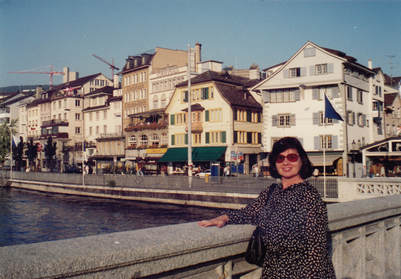
              On an autumn morning in 1992, we landed in Zurich, Switzerland.  Back then, the city still retained some of its old world charm and was easy to explore on foot.  In a medieval square, we even encountered students trying to raise cash as street musicians and mimes.
              "Where are you from?" Sherrill asked a motley dressed young man.
              "California," he replied.  "Berkeley." 

​              The  collection in the art museum surprised and impressed us (another Rembrandt postcard went off to our friend in Berkeley) and we enjoyed the arboretum by the Zurichsee, but the highlight of our time in Zurich probably was the Fraumunster church, the blue spire above its slender tower a perfect landmark.  Inside the little 13th century stone building, we found a striking 1940s stained glass window by Giacometti and five astonishing windows of Old Testament scenes, plus one dedicated to Christ, created by Chagall in 1970.  As we moved among them, light streaming through the glass, the bold lines and colors reached out to us, as if they were alive. 
PictureSherrill in Zurich, Switzerland
         One of the bittersweet aspects of our travels was that sooner or later we moved on.  We continued to Basel, where we'd find our boat to continue our journey.  As pleasant as it was to wander among the historic squares of this university town, the time came that evening to board the ship.  
        "How can you sleep?" Sherrill demanded in the middle of the night, shaking me as it began its journey north on the Rhine.  "We're moving!"
             "I know." 
       But I joined her at our cabin window, gazing out at the moon's reflection on the dark water and the lights dotting the shore. 
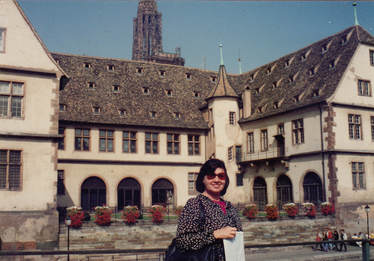
              The first stop, the next day, was the medieval city of Strasbourg in French Alsace.  Not in Germany, yet, but on the border.  We took far too many photographs (this was in the days of film), but couldn't resist snapping when confronted with the weathered red sandstone cathedral, the medieval bridge with four great towers, and the half-timbered houses of the old city center. 
              "I suppose you're going to climb that." Sherrill asked, when she saw me gazing up at the cathedral tower.  "Here, you'd better take this.  You'll want proof that you did it."
              I took the camera and snapped some shots when I went up, but the photos of the rooftops weren't too exciting. 

PictureSherrill in Strasbourg, Germany
​        I hadn't realized that we'd be passing through several locks along the river, but we did, later that day and the next day, too—large, noisy ones, at that.  The university town of Heidelberg wasn't on the Rhine, but we had to see it, anyway, and it wasn't far from the river.  The old city wasn't bombed during World War Two, so its historic sections survived and felt almost like movie sets as we strolled through them.  
        Sherrill and I never could resist the picturesque and romantic, so the next section of the Rhine easily excited our imaginations: castles on all sides, dramatic cliffs, vineyards bright with autumn colors, and villages studded with gothic and Romanesque churches.  The river was surprisingly busy along there, with barges, ferries, yachts, and occasional cruise ships.  We  passed the notorious Lorelei rock, more than 400 feet high, from which—according to legend and poetry—a lovely maiden sang her siren song to lure sailors to their deaths.  Whether not the tale was true, the scene was beautiful and dramatic enough to believe its attraction.  
         "Of course," Sherrill commented, "all those boats sank because of a wicked female, not poor navigation!"   

​           The Rhine cruise ended at Cologne, but it wasn't the end of our boating adventures on this trip.  The city had been almost entirely rebuilt since 1945, but it made a convenient base for further explorations.  We'd known that the city was badly bombed by the allies during the War, but they managed to avoid the huge gothic cathedral, although the train station next door was leveled.  It looked magnificent, but rather lonely, looming above the modern buildings around it.  
          During her research, Sherrill had managed to discover a restaurant in one of the few authentic medieval buildings left in Cologne's old town next to the Rhine—a perfect place to celebrate our 28th wedding anniversary.  I remember that it had a pricy wine list and a lot of rich desserts and that Sherrill indulged in the house specialty, grilled pig knuckles, but I don't recall what I had for my main dinner.  Whatever it was, I'm sure it was less interesting. 
           Sherrill had figured out how we could squeeze in a day trip to Mainz so that we could visit the Gutenberg Museum.  The city also was bombed during the War, but part of the old town survived, including the Romanesque cathedral and enough of the renaissance building that housed the Gutenberg museum so that it could be restored and its historical artifacts returned, including some of the first movable type printing presses and two Gutenberg Bibles.  Words and books have always been at the center of my life, but I was surprised by how emotional I felt gazing at those primitive printing presses.  
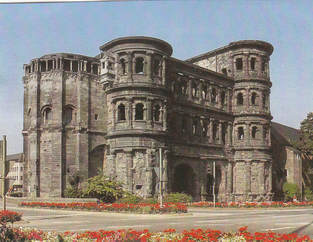
Picture"Porta Nigra," Roman Gate, Trier, Germany
​       Sherrill told me that she was sure that the next stop would be my favorite on the trip.  Maybe it wasn't my single favorite, but it was one of them.  From Cologne we took a train to the ancient city of Trier, Germany's oldest town and once the capital of Rome's western empire.  As we got off the train, we were confronted with proof, the massive Porta Nigra, so-called because of its dark stone, the largest stone gate the Romans ever built.  Exploring the remains of the Imperial Baths, one of the largest in the Roman empire, and the huge Imperial Palace was almost like stepping into one of those Technicolor epics of our youth: Quo Vadis, Cleopatra, Ben Hur, and Spartacus.  
     Our timing also was lucky, because in addition to ancient Rome we hit Trier during the Federweisserfest.  Tables were set out with bottles of Federweisser, a young white wine sold only in September and October, called "white feather" wine because it's still fermenting and a bubbly white color.  We liked it, so we bought a bottle to take back to the hotel.  We also liked the onion "cake" always sold with it, really an onion tart, and bought a couple to join the fedderweisser.  The wine seemed very light, but by the time we fell into bed, we might have been in ancient Rome. 
          Maybe it was the wine from the evening before, but in the morning we made a point of visiting the house in Trier where Karl Marx was born.  A typical early 18th century middle-class home, it wasn't particularly distinguished, but it had been turned into a combination museum, library, and research center for Marx and Engels studies.  My radical youth never would have forgiven me if I'd missed it.  

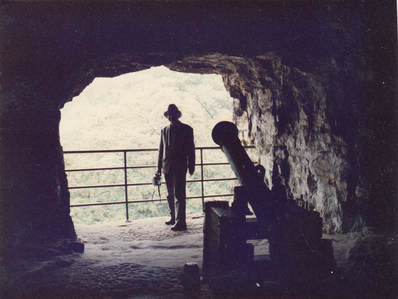
PictureBruce in Luxembourg City Fortifications
       About now, Sherrill repeated—with a smile, of course—one of her favorite phrases: "As long as we're so close...."  This time, I had to admit, the idea was not a stretch.  
       I don't remember exactly how far Trier was from Luxembourg City, but less than an hour by train got us up there.  And by the time we stepped off that train, we'd also got a good idea why the place was called the "Gibraltar of the North." 
         To start with, the city was perched on steep, massively fortified cliffs that dropped to deep, narrow valleys and gorges.  From the original medieval castle, the city walls and network of underground fortifications and defenses had grown into the stupendous result that we saw.  During WW II, they were used as bomb shelters for 35,000 people.  Although the country was officially neutral, the Nazis quickly occupied it and declared it part of Germany.  Walking through the gloomy hollowed out fortifications under the capital city was a strange experience. 
        A favorite memory from this trip is of when Sherrill and I were walking together through those underground casements that had been dug centuries before into the steep sides of the cliffs beneath what became Luxembourg City.
        "Just think," I said, "what it would have been like down here while the city up there was being bombarded, all this shaking around us, dirt falling, feeling that we might be buried alive any moment."
           "Too much imagination, sweetie," she said, taking my chin between her fingers and giving me a little kiss.  

         Back on the surface, the city seemed to leap from high point to high point, connected by bridges and viaducts, old and new jumbled together.  We'd never seen a city like it.  It was as beautiful as it was unique.  Suddenly, Sherrill clutched my wrist and pointed across a busy square to a sign proclaiming:  "Tex- Mex!  Chi-Chi's: the Spirit of the Old West."
         All that hiking and climbing had given us appetites and after days of heavy German food, we were ready for something different.  Margaritas and chips with salsa were only the beginning.  Then, eventually, we descended back to Trier and a day later traveled by boat to Bernkastel on the Moselle river.  
PictureSherrill, Bernkastel, Germany
     We decided that Bernkastel in the wine growing center of the Moselle river was one of the prettiest towns in Germany, even though for a while it looked as if we'd arrived on the last local boat that would ever stop there.  No boat, no train, no way out!  At least, there was a fast food chain called Nord Sea, specializing in seafood, which we consumed while being attacked from loudspeakers by ancient American pop tunes.  We enjoyed walking among the half-timbered medieval buildings and in the old Markt Platz we almost could feel as if we were in the middle ages—except that it all was too brightly painted and much, much too clean, and didn't stink.  Eventually, we found a room in a 150 year old hotel and, instead of worrying, explored the cobbled squares, admired the gabled, half-timbered houses with their overhanging upper stories, and dropped in at a wine tavern.  What would happen, would happen.  
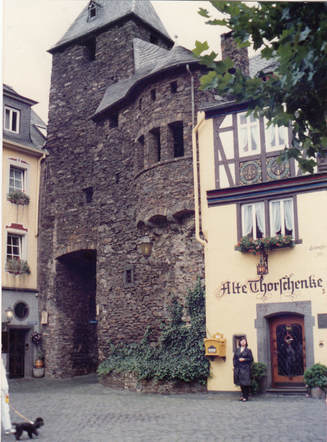
      The next day, we made it to the town of Cochem on the Moselle, but not by boat—with a combination of taxi and train.  This time, the room we found was in a 300 year-old inn huddled next to a Medieval city gate.  We weren't sure what we'd be doing day-to-day, now, or even hour-to-hour, but were enjoying ourselves and seeing a lot. And were drinking more of the federweisser wine and other wines, as well—after all, we could see the vineyards rising in terraces up to a hilltop castle, so we might as well get to know the local product.  The many bends and twists in the Moselle of this area made it resemble a piece of yarn a cat had been playing with.  Sometimes, it came very close to doubling back on itself. 
          The large, ornate castle on the peak above the town was an obvious fake, a nineteen century fantasy that in the 19th century had replaced an authentic ruin.  It belonged as a backdrop in a Ruritanian operetta, but we rather liked it, just as we were amused by the amateur oompah-pah band that we watched stumble past the half-timbered buildings.    
To be continued....  
​

​If you enjoy these posts, why not explore the rest of my website, too? Just click on the buttons at the top of the page and discover where they take you—including to several complete short stories and excerpts from my novels.  Please pass them on to anybody else you think might enjoy them.    
0 Comments

    Author


          I've been writing at least since age seven, making up stories before that, and exploring the world almost as long as I can remember.  This blog is mostly about writing and traveling -- for me the perfect life. 
          Please Bookmark my blog, so you won't miss any posts.
          My most recent book is DELPHINE, winner of the Clay Reynolds Novella Prize.        Recently, my first novel, THE NIGHT ACTION, has been republished by Automat Press as an e-book, available from Amazon, Barnes & Noble, and other sources.  CLICK here to buy THE NIGHT ACTION e-book.

    Archives

    December 2018
    November 2018
    October 2018
    September 2018
    August 2018
    July 2018
    June 2018
    May 2018
    April 2018
    March 2018
    February 2018
    January 2018
    December 2017
    November 2017
    October 2017
    September 2017
    August 2017
    July 2017
    June 2017
    May 2017
    October 2015
    September 2015
    August 2015
    June 2015
    May 2015
    April 2015
    March 2015
    February 2015
    January 2015
    December 2014
    November 2014

    Click HERE to buy DELPHINE
    Click Here to buy new e-edition of THE NIGHT ACTION

    Categories

    All

    RSS Feed